Shopify is the faster, more complete platform, and WooCommerce is the cheaper one. For most first Indian stores we choose between them on budget. If you can pay for Shopify and want fewer things to maintain, pick Shopify. If budget is the limit, WooCommerce on good hosting does the job and costs less, especially while sales are small.
We have run many Shopify and WooCommerce stores at Brand E5. We cannot share client specifics, but the pattern is steady: the budget decides the platform far more often than any feature does.
How do Shopify and WooCommerce work?
Shopify is a hosted service. You pay a monthly plan, and Shopify runs the servers, security and updates. It also comes with the speed optimisations a store needs, so a few small tweaks are enough to get good results.
WooCommerce is a free plugin that turns a WordPress site into a store. You buy the hosting, pick a theme, add extensions and keep everything updated. That gives you more control and a lower starting cost, and it also makes you responsible for speed.
In our experience Shopify is faster and better than WooCommerce in almost every respect. WooCommerce wins on budget. Give it the budget for optimisation and it can be just as fast, but the work has to be done, whereas on Shopify most of it is already in the box. This is our opinion, from running both.
How much does a store cost in the first year?
Here is one store worked through on both platforms. The sales figure is an assumption we picked to make the sum easy, so replace it with your own: 100 orders a month at an average of ₹1,500, which is ₹1,50,000 in monthly sales.
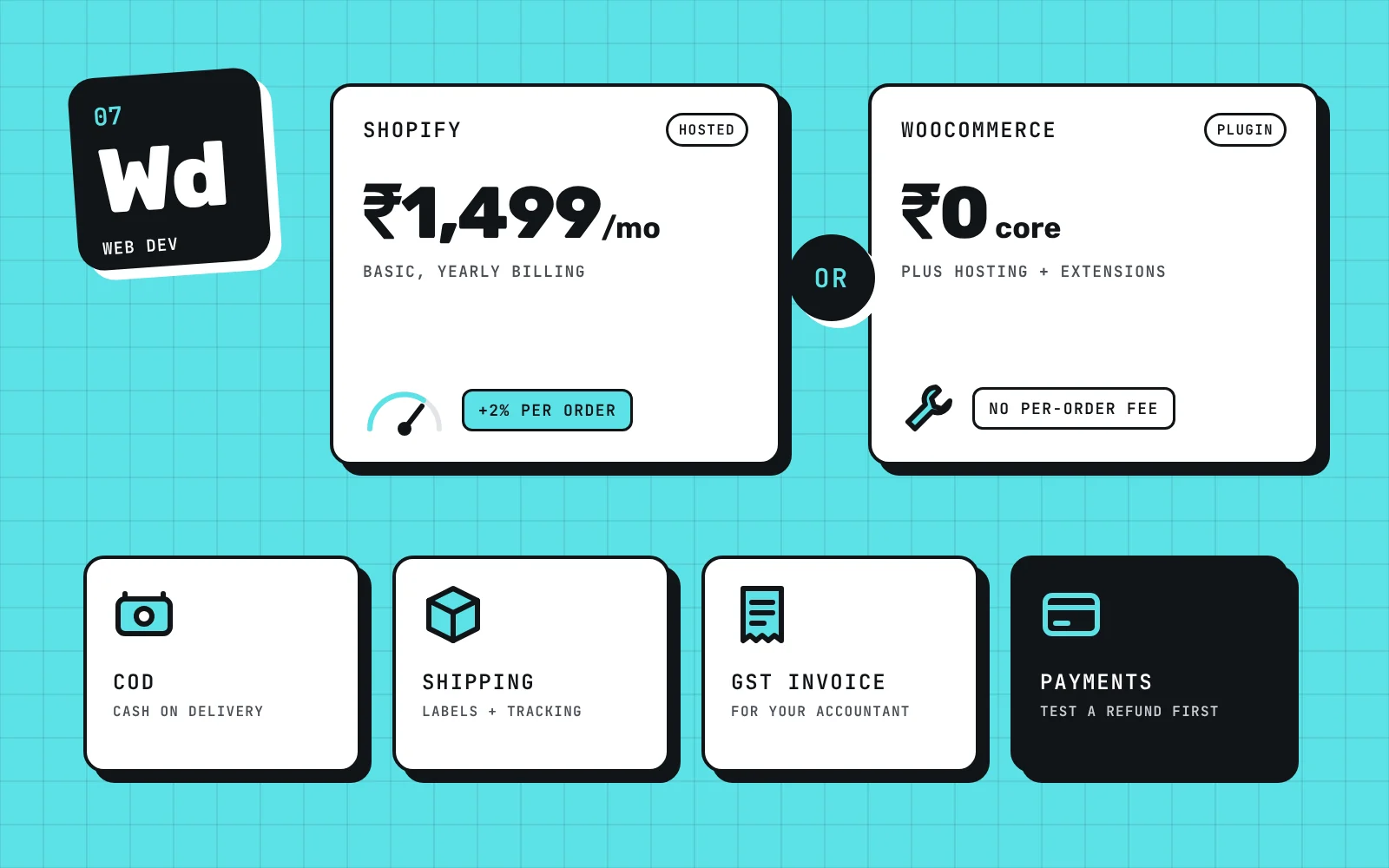
Shopify. According to Shopify’s India pricing page, as of November 2026, the Basic plan is ₹1,994 a month, or ₹1,499 a month on yearly billing. On yearly billing that is ₹17,988 for the year. Shopify also charges a fee of 2% on Basic when you take payments through an outside gateway such as Razorpay. On ₹1,50,000 of monthly sales that is ₹3,000 a month, or ₹36,000 a year. The gateway’s own charges come on top, and they are the same on either platform.
| Shopify, first year | Amount |
|---|---|
| Basic plan, yearly billing | ₹17,988 |
| 2% fee on outside gateway (at ₹1,50,000 monthly sales) | ₹36,000 |
| Total, before setup, apps and gateway charges | ₹53,988 |
WooCommerce. The core plugin is free, and WooCommerce.com says so plainly, with no monthly subscription and no fee on each order. The costs are everything around it: hosting, a theme, extensions and someone to keep the store updated. WooCommerce.com lists hosting alone at about $25 to $350 a month for most stores, and paid extensions at roughly $29 to $299 a year each. What you spend depends on how many of those you need, so we price it from your list.
At ₹1,50,000 a month, Shopify’s plan and that fee come to ₹53,988 a year. The part to notice is that Shopify’s 2% fee rises with your sales and WooCommerce has no such fee. At ₹5,00,000 a month, that fee alone is ₹1,20,000 a year, and that is where having no per-order fee starts to matter.
These figures cover the platform, not our setup fee, and they leave out gateway charges and any apps you add. Check them against the current Shopify page before you decide.
What do I need to set up for COD, shipping and GST?
India adds three things to any store: cash on delivery, shipping and GST invoices. This is the stack we usually set up:
| Requirement | Our recommendation | Alternative |
|---|---|---|
| Online store | Shopify | WooCommerce |
| Shipping | Shiprocket | NimbusPost |
| Payment gateway | Razorpay | Cashfree |
| GST invoices | Woo GST plugin (WooCommerce) | Invoxa GST |
| Accounting | Zoho Books | TallyPrime |
| WhatsApp notifications | Interakt, with a custom setup | AiSensy |
Cash on delivery works on both platforms, and we set it up on every Indian store we build. If your customers are in smaller cities, plan for COD from the start, because returned COD parcels are a cost you carry.
Shipping is the next piece. We usually connect Shiprocket, which handles courier selection, labels and tracking, and keep NimbusPost as the alternative. The store sends each order across, and the tracking link goes back to the customer without anyone copying details by hand.
For invoices, a custom setup or Zoho Books is common. On WooCommerce we use a GST plugin, and on Shopify an invoicing app or a custom solution. We connect whichever fits your accountant’s workflow, so the invoice carries the details your accountant needs for filing.
Payments are the simplest part. Razorpay is our usual gateway, with Cashfree as the alternative. Set it up early and test a real payment and a refund before you launch, not after your first customer asks.
Who looks after the store after launch?
Usually the owner. We provide full handover training across a one-month support window, so by the end you know how to add products, process orders, change prices and read the reports.
What owners tend to underestimate on WooCommerce is the upkeep: updates, backups, security and plugin conflicts. On Shopify the platform takes most of that off you, and what remains is app subscriptions that quietly add up. Whichever you pick, put a name and a monthly time slot against the store’s upkeep on the day you launch.
So which one should you pick?
Our pick for a first store with a workable budget is Shopify. It is faster out of the box, it needs only small tweaks to perform, and there is less that can break while you are busy selling.
Pick WooCommerce when budget is the limit. It also suits you if you already have a WordPress site to extend, or if your sales are high enough that a fee on every order starts to hurt. Both can be done well. Neither survives being set up carelessly.
We do build stores. Setup is priced from our business website package and rises with the add-ons you need, such as shipping, GST and WhatsApp notifications. See our web development service page for how we work, and our guide to what a business website costs in India for the wider picture.
What to do next
Write down your expected orders and average order value for the first six months, and whether most of your customers are in a metro or a smaller city. With those three numbers we can tell you which platform fits and what it will cost. Book a free audit and bring them with you.
Sources
- Shopify India: Pricingshopify.com
- WooCommerce: Pricingwoocommerce.com
Questions people ask
Is Shopify or WooCommerce better for a small Indian store?
Shopify is the better product in speed and built-in optimisation. WooCommerce is cheaper to start, and with the budget for optimisation it can match Shopify on speed. For a first store we choose by budget.
How much does Shopify cost in India?
As of November 2026, Shopify's India page lists Basic at ₹1,994 a month, or ₹1,499 a month on yearly billing. Grow is ₹7,447 a month, or ₹5,599 on yearly billing. Prices change, so check the page before you buy.
Is WooCommerce really free?
The core WooCommerce plugin is free. You still pay for hosting, a theme, extensions and someone to maintain the store. WooCommerce.com says hosting alone runs about $25 to $350 a month for most stores.
Do both platforms support cash on delivery?
Yes, both support it, and we set it up on every Indian store we build. Plan for it from the start if your customers are in smaller cities.
Who looks after the store after launch?
Usually the owner. We provide a one-month support window with full handover training, so the owner knows how to run the store when it ends.

Bharath Yadav
Bharath Yadav founded Brand E5 to run marketing, websites and AI as one system. He has spent more than ten years on every side of growth: writing production software, advising Google Ads partners at Google Operations Center, and leading a team of 80 across two offices. He shipped his first client website in 2016.
More about Bharath